
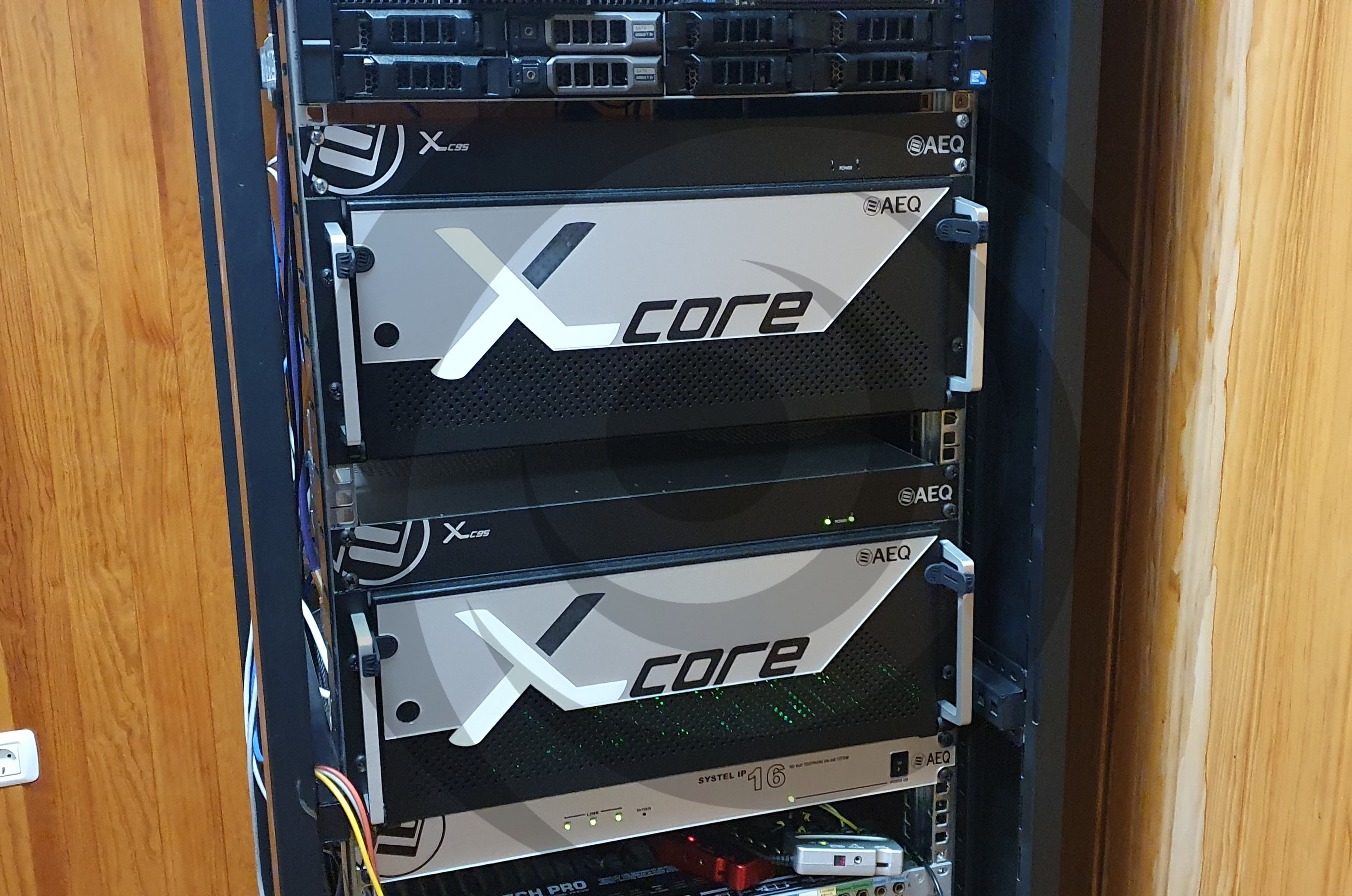
X_CORE
Interested in this product?
Request informationAoIP Routing System
With more than one thousand channels per matrix, it is possible to configure systems with a total capacity of more than five thousand channels. X_Core is the result of more than 20 years of experience in the design and construction of digital audio routing matrix systems for broadcast applications.
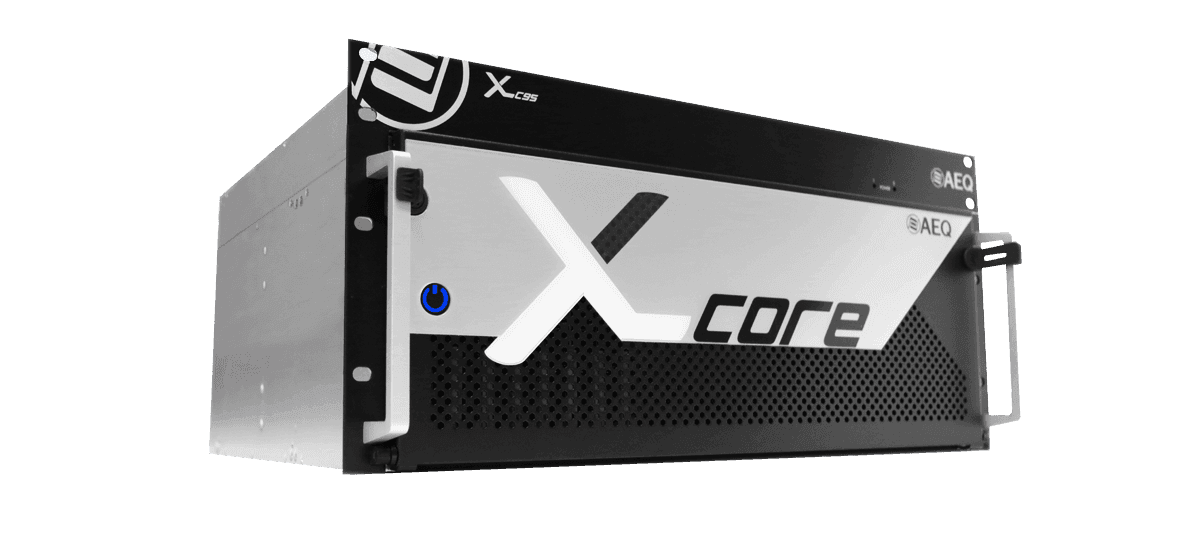
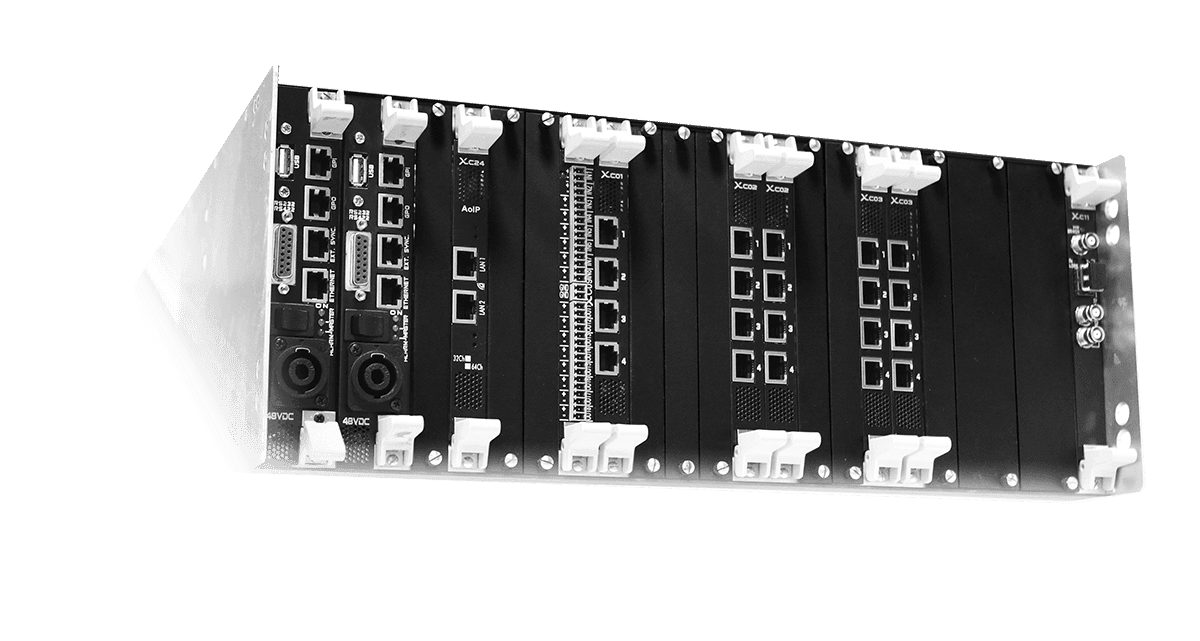
Cutting-edge technology offering the most innovative features!
PDFDownload catalogueX_Core Technical Specifications
- 1,024-circuit blocks. Configurations of up to 5,080 × 5,080 circuits can be achieved by linking several blocks with the TITAN concentrator.
- Radio frequency protection.
- Electronically balanced microphone and line inputs. Analogue headphone outputs.
- Electronically balanced analogue line inputs and outputs. Transformer-balanced analogue line I/O option available.
- Digital I/O configurable as: AES/EBU (AES3) and SPDIF, mono and stereo.
- Digital I/O groupable as AES10 (MADI), mono and stereo, one or two 64-channel interfaces, 48 kHz, single-mode fibre, or multimode with SFP receptacles and removable cartridges.
- Audio-over-IP I/O, Dante protocol, AES67 and SMPTE ST 2110-30 compatible, 64 channels per card, 48 kHz.
- Audio-over-IP I/O, RAVENNA protocol, AES67, SMPTE ST 2110-30 and SMPTE ST 2110-31 compatible. NMOS control. 128 channels per card, 48 kHz.
- Audio-over-IP I/O, G.722 compressed for intercommunication, 12 channels per card.
- Digital audio I/O embedded in SDI/3G video, per SMPTE 259 M, 292 M and 424 M. Each card has two input and two output interfaces with 2×16 audio inputs and 2×16 audio outputs.
- Via optocoupler on some I/O cards.
- GPI via optocoupler and GPO via relay on controller cards.
Internal synchronisation throughout the entire X_CORE system. Accepts and delivers synchronisation via WORDCLOCK and AES11 connections, as well as through AES/EBU, AES10, DANTE (PTPv1 and PTPv2), AES67 (PTPv2) and RAVENNA (PTPv2) signals. Synchronisation from the Genlock input of the SDI card (PTPv2) and RAVENNA (PTPv2) is also accepted.
- Internal sampling frequency 48 kHz, 24 bits.
- Internal bus format: two buses, 32 bits per sample, floating point.
- Input and output routing.
- Gain control on line-level signals: -12 dB to +12 dB.
- Gain control on mic-level signals: -40 dB to +24 dB.
- Stereo spatial distribution (Balance/Pan).
- Modulation continuity control.
- Test generators: pink and white noise, tone generators with configurable frequency and burst mode.
- Dynamics: compression, limiting, expansion, combined DLP, noise gate.
- Frequency: high-pass, low-pass, band-pass filters, 4-band parametric equalisation and de-esser.
- Delay.
- Reverb.
- Manage the frame configuration and its relationships with the outside.
- Manage the timing of the entire system, centralising the synchronisation sources.
- Manage power alarms produced on any of the cards, activating the "ALARM" LED if a fault is detected.
- Manage master/slave mode (when two controller cards are used).
- Supply power to the entire frame.
Incorporates an industrial PC board with a real-time operating system stored together with the configuration data on a Compact Flash memory. Its functions include, among others:
Complete your project with...
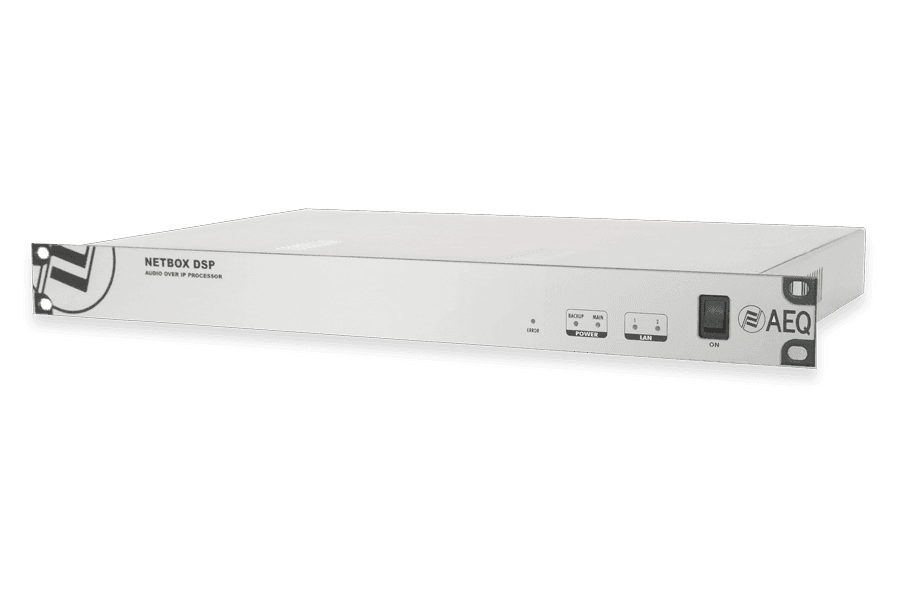
NETBOX DSP
NETBOX DSP
Scalable audio matrix with 64 to 160 audio inputs and outputs, capable of receiving audio from a Dante or AES67 network and returning it mixed and processed for use in other equipment or subsystems. It can also generate test signals and send vumeters.
Input and Outputs▼
– Dante / AES67 channels, according to internal configuration: • 64 bidirectionals. • 96 bidirectionals. • 128 bidirectionals. • 160 bidirectionals. – Additional tone generator input: 1 KHz. +4 dBu (-20 dBFS). – Bandwidth: 20 to 20.000 Hz @ +/- 0.5 dB.
Level Indicator and meters▼
– Bank of mono or stereo AoIP input and output level meters in Netbox RTC software. – Precision level metering of a mono or stereo AoIP input or output in Netbox RTC software. – 4-color level indicator for all audio inputs and outputs in Netbox RTC software. – Configurable low signal level alarm for any input and output in Netbox RTC software.
GPIOs▼
– 16 physical GPIs at 2 DB15 connectors, including +5V power supply pin. – 16 physical GPOs at 2 DB15 connectors, including +5V power supply pin. – 246 virtual GPIOs that may be used to perform any of the following functions: – Transportation of signalling between devices. – Reporting audio presence at any input. – Indicate audio absence in any output. – Remote muting of any output. – Activation and triggering of macros and salvos. – Physical GPI and GPO are standard GPIO, while virtual GPIO use AEQ's proprietary protocol, although it is starting to be implemented by several integrators. GPIO can also be transported through the IP network between compatible devices. This way, a GPI can drive GPOs in other equipment. This is what we call "Virtual GPIO".
Redundancy▼
– NETBOX DSP device features a redundant power supply. In case that one of them stops receiving mains or fails, the system is fed by the other one without any operation disruption. – NETBOX DSP includes two Ethernet ports. These may be configured in "Daisy Chain" mode, Primary / Secondary or Master / Slave modes. – When Primary/Secondary redundancy mode is configured, the device uses Dante native redundancy system, which allows for Primary/Secondary failover without losing audio samples as seamless changeover.
Mixing▼
– NETBOX DSP can also mix any of its inputs to any output that was enabled for it in the configuration process. This means that any set of inputs can be mixed to any of the outputs. At each input, output, and cross-point for an input and output, the gain can be modified. Any output can also be muted.
Network Technology DANTE▼
– Data format: Dante Audio over IP technology. AES67 compatible. – Plug-and-play technology – automatic detection of the hardware and simple audio routing. – Precise sample-level synchronization, even through several switches. – Very low and deterministic delay in the entire network. – Flexible and scalable network topology, supporting a great number of audio transmitters and receivers. – Supports a single integrated network used for audio, video, control and monitoring. Compatible with other kinds of traffic using QoS management. – Uses low-cost, on-the-shelf network infrastructure. – 24-bit, 48 KHz audio resolution. – Delay: 1-2 ms (@ 48 KHz typical, depending on network performance and complexity). – 2 RJ45 Ethernet ports per interface, 1000 BASE-T, transformer isolated, usable for redundancy or daisy-chain connections. – Binary rate: 100/1000 Mbps. – Maximum segment length: 100m max. over CAT5e or better cabling.
Audio Processing▼
– NETBOX DSP provides an "AGC" (Automatic Gain Control) function which can be applied to any of the AoIP inputs and outputs without limits. Simple adjustment, only a target level in dBFS needs to be specified. – In addition, the device can perform one or more of the following processes up to 64 channels, either input or output, mono individual or grouped in stereo pairs: • High pass filter. • Low pass filter. • Band filter. • 4-band parametric equalizer. • Combined DLP (Dynamic Level Processor) up to 5 points, with 4 process sections depending on the level: • Compressor. • Expander. • Limiter. • Noise gate. • Delay.
General Specifications▼
– Cooling: Absolutely quiet natural convection cooling system, compatible with studio operation. – Dimensions and weight: 44 x 482 x 356 mm (1.73″ x 19″ x 14″). 3.5 Kg. (7.7 lbs). – Power supply: Redundant internal power supply (90 – 264V AC, 47-63Hz). – Temperature range: -10 to +45 °C (32 to 114 °F). – Easy to install: NETBOX DSP is a 19″ rack unit with 1U height. – Versions: DSP 64: Processes 64 signals, routes and mixes 64 signals. DSP 96: Processes 64 signals, routes and mixes 96 signals. DSP 128: Processes 64 signals, routes and mixes 128 signals. DSP 160: Processes 64 signals, routes and mixes 160 signals.
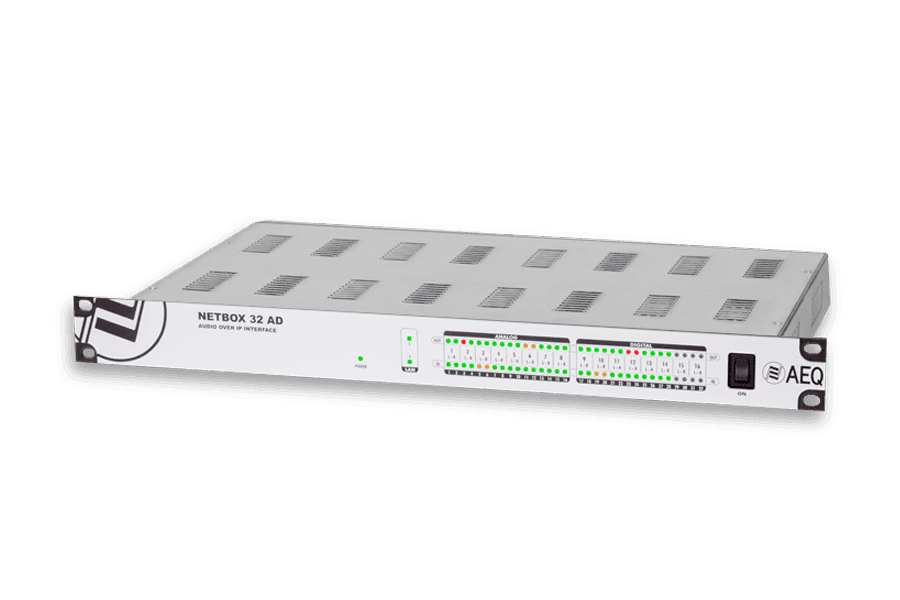
NETBOX 32 AD MX
NETBOX 32 AD MX
It is a 64 × 64 circuit audio matrix mixer and distributor. It can route each of its 16 analogue, 16 digital and 32 IP network inputs to any or all of its 64 outputs (16 analogue, 16 digital and 32 IP).
Input and Outputs▼
– Analogue channels: 16 bidirectional channels. – Dual or Stereo digital channels: 8 bidirectional channels. – Dante / AES 67 channels: 32 bidirectional channels. – Additional tone generator input: 1 KHz. +4 dBu (-20 dBFS). – Bandwidth: 20 to 20.000 Hz @ +/- 0.5 dB. – Balanced electronically analogue line-level inputs and outputs. – Maximum analogue input and output level: +24 dBu. – Nominal analogue input and output level: +4 dBu (-20 dBFS).
Level Indicator and meters▼
– Three-color level indicator for all analogue and digital inputs and outputs at the unit's front panel. – Bank of mono or stereo AoIP input and output level meters in Netbox RTC software. – Precision level metering of a mono or stereo AoIP input or output in Netbox RTC software. – 4-color level indicator for all audio inputs and outputs in Netbox RTC software. – Configurable low signal level alarm for any input and output in Netbox RTC software.
GPIOs▼
– 16 physical GPIs at 2 DB15 connectors, including +5V power supply pin. – 16 physical GPOs at 2 DB15 connectors, including +5V power supply pin. – 246 virtual GPIOs that may be used to perform any of the following functions: – Transportation of signalling between devices. – Reporting audio presence at any input. – Indicate audio absence in any output. – Remote muting of any output. – Activation and triggering of macros and salvos. – Physical GPI and GPO are standard GPIO, while virtual GPIO use AEQ's proprietary protocol, although it is starting to be implemented by several integrators. GPIO can also be transported through the IP network between compatible devices. This way, a GPI can drive GPOs in other equipment. This is what we call "Virtual GPIO".
Redundancy▼
– NETBOX 32 AD MX device optionally features a redundant power supply. In case that one of them stops receiving mains or fails, the system is fed by the other one without any operation disruption. – NETBOX 32 AD MX includes two Ethernet ports. These may be configured in "Daisy Chain" mode, Primary / Secondary or Master / Slave modes. – When Primary/Secondary redundancy mode is configured, the device uses Dante native redundancy system, which allows for Primary/Secondary failover without losing audio samples as seamless changeover.
Mixing▼
– NETBOX 32 AD MX can also mix any of its inputs to any output. This means that any set of inputs can be mixed to any of the outputs. Each output gain can be individually adjusted. They can also be muted.
Network Technology DANTE▼
– Data format: Dante Audio over IP technology. AES67 compatible. – Plug-and-play technology – automatic detection of the hardware and simple audio routing. – Precise sample-level synchronization, even through several switches. – Very low and deterministic delay in the entire network. – Flexible and scalable network topology, supporting a great number of audio transmitters and receivers. – Supports a single integrated network used for audio, video, control and monitoring. Compatible with other kinds of traffic using QoS management. – Uses low-cost, off-the-shelf network infrastructure. – 24-bit, 48 KHz. audio resolution. – Delay: 1-2 ms (@ 48 KHz typical, depending on network performance and complexity). – 2 RJ45 Ethernet ports per interface, 1000 BASE-T, transformer isolated, that can be used for redundancy or daisy-chain connections. – Binary rate: 100/1000 Mbps. – Maximum segment length: 100m max. over CAT5e or better cabling.
Audio Processing▼
– NETBOX 32 AD MX provides an "AGC" (Automatic Gain Control) function which can be applied to any of the AoIP inputs and outputs without limits. Simple adjustment, only a target level in dBFS needs to be specified.
General Specifications▼
– Cooling: Absolutely quiet natural convection cooling system, compatible with studio operation. – Dimensions and weight: 44 x 482 x 361 mm (1.73″ x 19″ x 14.21″). 4.5 Kg. (9.92 lbs). – Power supply: Internal power supply (90 – 264V AC, 47-63Hz). Optionally redundant. – Temperature range: -10 to +45 ºC (32 to 114 ºF). – Easy to install: NETBOX 32 AD MX is a 19" rack unit with 1U height.